India

Quick answer
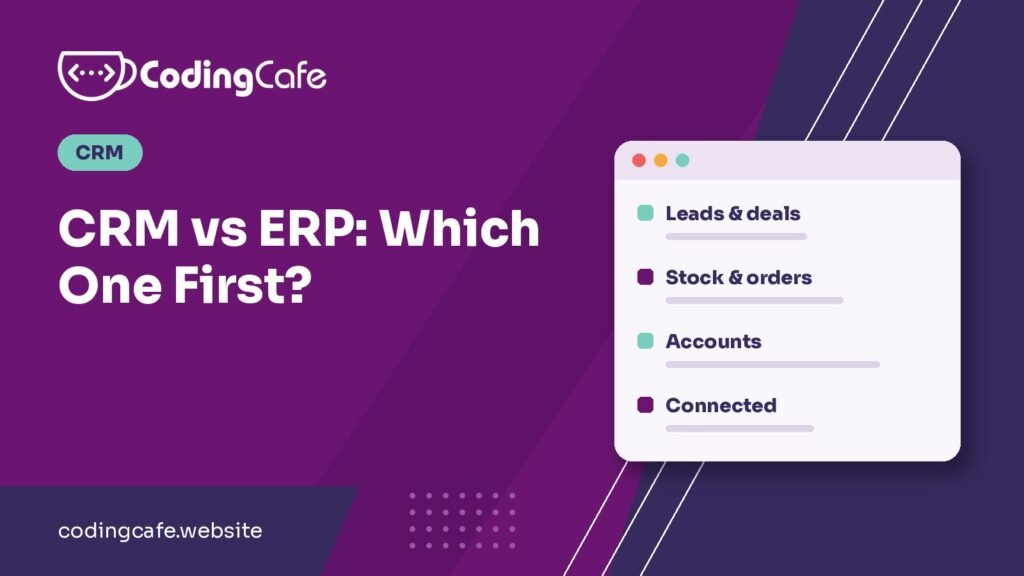
A CRM (customer relationship management) handles everything with customers: leads, follow-ups, deals and support. An ERP (enterprise resource planning) runs the operations behind the sale: purchase, stock, production, invoicing and accounts. Get a CRM first if you are losing leads and follow-ups; get an ERP first if stock, costing or accounts are the problem. The two connect when a won deal becomes a sales order.
Key takeaways
- A CRM faces customers: leads, follow-ups, deals and support. An ERP faces operations: stock, purchase, production and accounts.
- Service businesses with little inventory usually need a CRM first; manufacturers and traders usually need an ERP first.
- The two systems meet when a deal is won and becomes a sales order, so they should be connected.
- Odoo, ERPNext and Zoho offer both, but a dedicated CRM is stronger for high lead volumes.
- Tally covers accounts, GST and stock, but it is not a CRM.
Jump to section
Picture a growing distributor in Ludhiana. The sales team keeps leads in a WhatsApp group and a shared Excel sheet. The accounts team lives in Tally. The warehouse has its own register. Every Monday the owner asks three people three questions and gets three slightly different answers.
At some point somebody says “we need software,” and the next question is always the same: do we need a CRM or an ERP? They sound similar, they’re both sold as “the system that runs your business,” and some products claim to be both. They’re actually solving two quite different problems, and once you see which problem is hurting more, the choice gets much easier.
What a CRM does
CRM stands for customer relationship management. A CRM looks after everything that happens with a customer: the enquiry arriving, the follow-up calls, the quote, the deal being won or lost, and the service and repeat orders afterwards. If you want the longer explanation, our free lesson on what a CRM is starts from zero.
The people who live in a CRM are sales, marketing and customer support. The questions it answers are things like: where did this lead come from, who’s following it up, when did we last speak to them, and how many enquiries turned into sales this month?
What an ERP does
ERP stands for enterprise resource planning. An ERP runs the operations behind the sale: purchase, stock, production, dispatch, invoicing, accounts, and often payroll. It’s the system that knows what you have, what it cost, what you owe and what you’re owed.
The people who live in an ERP are accounts, purchase, stores, production and management. Its questions are: how much stock do we have, what did this unit cost to make, which invoices are overdue, and what’s our margin on this order? If you run a factory, our guide to ERP software for manufacturing shows what that looks like in practice.
CRM vs ERP side by side
| CRM | ERP | |
|---|---|---|
| Main job | Win and keep customers | Run operations and money efficiently |
| Faces | Outward, towards customers | Inward, towards the business |
| Main users | Sales, marketing, support | Accounts, purchase, stores, production, HR |
| Core data | Leads, contacts, deals, calls, messages, tickets | Items, stock, orders, invoices, ledgers, costs |
| Measures success by | More enquiries converted, faster follow-ups | Lower costs, accurate stock, clean books |
| Typical Indian examples | Zoho CRM, LeadSquared, Kylas, TeleCRM | TallyPrime, Odoo, ERPNext, SAP Business One |
| Usual pricing | Per user per month, or a custom build | Licence or per user, plus heavier implementation |
| Time to go live | Days to a few weeks for a ready-made tool | Weeks to months, because more departments move at once |
The short version: a CRM is about the front of the business, before and after the sale. An ERP is about the back of the business, everything needed to deliver and account for it.
Where they meet
The two systems touch at one moment: when a deal is won. The CRM has the customer, the quote and the agreed price. The ERP needs exactly that information to raise a sales order, reserve or produce stock, dispatch it and invoice it. Then the ERP knows something the sales team badly wants to know: has the customer paid, and has the order shipped?
When the two aren’t connected, someone retypes the order from one system into the other. That’s where the errors creep in: wrong rate, wrong GST number, an order that never got entered at all. A good setup passes the won deal from CRM to ERP automatically and sends payment and dispatch status back, so a salesperson can answer a customer’s “where’s my order?” without phoning accounts.
Which one should you get first?
Look at where your business is losing money or time today. That usually answers it.
Get a CRM first if
- Enquiries arrive from ads, your website, IndiaMART, property portals or WhatsApp, and some never get a reply.
- Follow-ups depend on a salesperson remembering.
- When a salesperson leaves, their leads and history leave with them.
- You can’t say which marketing channel brings customers who actually buy.
- Your operations are fairly simple, and Tally already handles billing and stock well enough.
Service businesses such as clinics, coaching institutes, real estate agencies, immigration consultants and agencies usually fall here. They have little or no inventory, so the expensive problem is lost leads.
Get an ERP first if
- Stock counts don’t match the books, or you run out of materials without warning.
- You make or assemble products and don’t know your real cost per unit.
- Purchase, production and dispatch are coordinated by phone calls.
- Month-end closing takes days of reconciling spreadsheets.
- You have a fairly steady set of repeat customers, so winning new leads isn’t the bottleneck.
Manufacturers, distributors and traders with real inventory usually start here, because an operations mess costs them more than a sales mess.
If both hurt
Fix the one that costs more money first, and make sure whatever you choose can connect to the other later. Ask any vendor directly: how does a won deal become a sales order, and can I get payment status back? If the answer is “export a CSV,” keep looking.
Can one system do both?
Yes, some can. Odoo and ERPNext both include CRM modules inside their ERPs, and Zoho sells its CRM and its accounting and inventory apps as a connected suite. If your sales process is simple, the CRM module inside your ERP may be enough, and having one database is a real advantage.
The catch is that the CRM inside an ERP is rarely as strong as a dedicated CRM. If your growth depends on handling lots of leads quickly, with auto-assignment, WhatsApp follow-ups, call logging and source tracking, a dedicated CRM connected to your ERP usually works better than an ERP’s built-in contact list. Our guide to the types of CRM helps you work out how much CRM you really need.
What about Tally?
Most Indian businesses already run Tally, so this comes up a lot. TallyPrime handles accounting, GST, invoicing and inventory very well, which covers a good part of what small businesses want from an ERP. It doesn’t manage leads, pipelines or follow-ups, so it isn’t a CRM. For many small firms, the practical answer is a CRM connected to Tally: deals are won in the CRM, invoices go out from Tally, and nobody types an order twice.
What they cost
A ready-made CRM for a small team usually costs a few hundred to a couple of thousand rupees per user per month, and our CRM software cost guide works through real totals. ERPs cost more to get running because more departments, more data and more training are involved; the licence is often the smaller part of the bill. A custom CRM starts at about ₹1.5 lakh and a custom ERP at about ₹2 lakh, both built in phases.
The quick test
Ask yourself one question: if you got twice as many enquiries next month, would the problem be handling the enquiries, or delivering the orders? If it’s the enquiries, start with a CRM. If it’s the orders, start with an ERP.
And if your process doesn’t fit either kind of off-the-shelf software, we build both. See our CRM development and ERP development pages, or use the estimate picker below for a starting figure.
Deciding between CRM and ERP
0 of 6 done
Need software that fits how your team works?
Pick what it should handle and leave a number or email. We reply with a price range within 24 business hours.
Frequently asked questions
What is the main difference between CRM and ERP?
A CRM manages customer relationships: leads, follow-ups, deals and support. An ERP manages business operations: purchase, inventory, production, invoicing and accounts. A CRM helps you win and keep customers; an ERP helps you deliver to them efficiently and account for it.
Which comes first, CRM or ERP?
It depends on where the business is losing money. Service businesses that struggle with lost leads and missed follow-ups usually start with a CRM. Manufacturers, distributors and traders that struggle with stock, costing or accounts usually start with an ERP.
Is Tally a CRM or an ERP?
TallyPrime is accounting and inventory software, closer to a small ERP. It handles GST, invoicing and stock but does not manage leads, sales pipelines or follow-ups, so it is not a CRM. Many small businesses connect a CRM to Tally.
Is Salesforce a CRM or ERP?
Salesforce is a CRM. It manages sales, service and marketing, and connects to ERPs such as SAP or Oracle for orders, stock and accounts.
Can one software do both CRM and ERP?
Yes. Odoo and ERPNext include CRM modules within their ERP, and Zoho offers CRM with connected finance and inventory apps. For simple sales processes that can be enough; for high lead volumes a dedicated CRM connected to the ERP usually works better.
Do small businesses need both CRM and ERP?
Not at first. Most small businesses start with one, often a CRM alongside Tally, and add the other as they grow. The important thing is choosing systems that can connect later, so orders are not typed in twice.
Not sure whether you need a CRM or an ERP?
Tell us what you are building and we will suggest the simplest path that fits your budget and timeline. No obligation.