 India


Quick answer
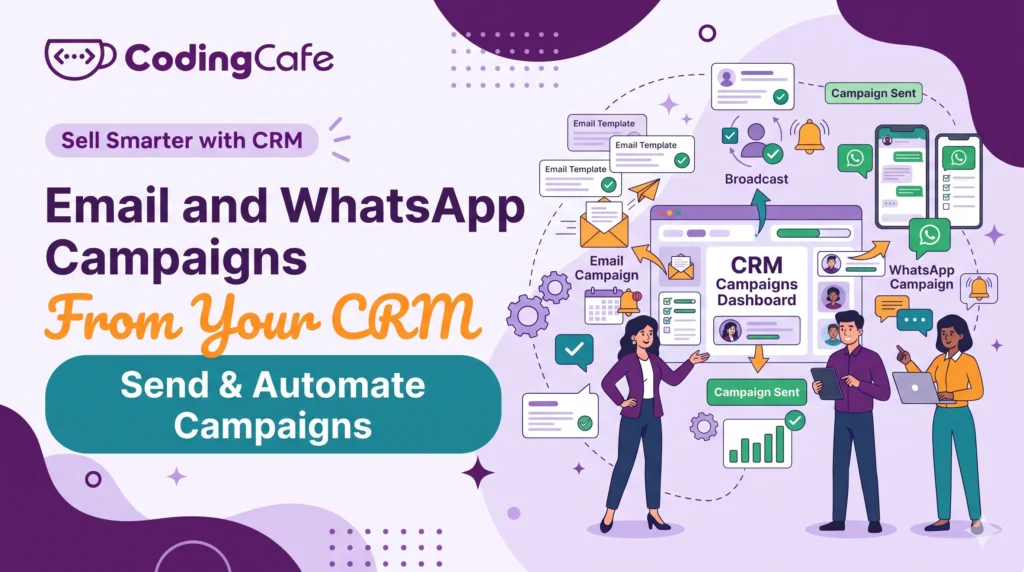
A CRM campaign is a message to a segment, a group chosen by what the CRM knows about them, not a blast to everyone. Three campaigns every small business can run: reviving enquiries lost on timing, nudging quiet customers past their repeat cycle, and matching past enquiries to something new. Use WhatsApp for targeted messages to small segments and email for monthly round-ups, record consent as a field, honour opt-outs the same day, and measure replies and deals, not opens.
Key takeaways
- People already in your CRM are the cheapest sales you will make; message segments, never everyone.
- Three campaigns from data you already have: lost-on-timing revival, quiet customer, the match.
- WhatsApp for targeted messages from a connected business number; email for monthly round-ups and documents.
- Consent is a field and opt-out is one word; measure replies and deals, not opens.
Most small businesses spend their marketing money on strangers. Ads, portals, listings, all aimed at people who have never heard of them. Meanwhile the CRM holds hundreds of people who have: past customers, old enquiries, people who asked for a quote last year and went quiet.
Those people are the cheapest sales you will ever make.
A campaign from the CRM is simply a message sent to a chosen group of them, on purpose, with a reason. This lesson is about choosing the group, writing the reason, and not becoming spam.
Segments, Not Blasts
The difference between a campaign and a blast is who receives it. A blast goes to everyone in the list. A campaign goes to a segment: a group chosen by something the CRM knows about them.
Because you filled in stage, source, lost reason, purchase date and requirement in Module 2, you can now ask the CRM for groups like these:
- Enquiries from the last 90 days that were lost with the reason “timing”.
- Customers who bought more than eleven months ago and have not reordered.
- Real estate enquiries who wanted a two-bedroom flat under ₹80 lakh, now that a matching project has launched.
- Everyone in “Quotation sent” for more than two weeks.
A message to a segment can say something true and specific. A message to everyone cannot, which is why everyone ignores it.
Three Campaigns Every Small Business Can Run
Start with these three. Each uses data you already have.
1. The lost-on-timing revival
Segment: deals lost in the last six months with a reason of “timing”, “budget” or “no response”. Message: one line acknowledging the earlier conversation, one thing that has changed (new stock, a payment plan, a seasonal offer, a new lesson in a series like this), and a question. Expect a small share to reply, and those replies are warm.
2. The quiet customer
Segment: customers whose last purchase or service is older than your usual repeat cycle. For a manufacturing distributor that is a dealer who has not ordered in two cycles. For an immigration consultancy it is a client whose visa is a year from renewal. Message: specific to what they bought, not a general newsletter.
3. The match
Segment: open or lost enquiries whose recorded requirement matches something you now have. The two-bedroom buyers when the right project launches. The dealers who asked about a product line that is back in stock. This is the campaign that makes the “requirement in one line” field worth filling in.
A real estate agency ran the match campaign to 140 past enquiries when a new tower launched. Eleven booked site visits in the first week, from a WhatsApp message that took twenty minutes to write.
Email or WhatsApp?
Both, for different jobs.
A sensible rhythm for most SMEs: WhatsApp for the three targeted campaigns when there is a reason, email once a month to everyone who opted in, nothing else.
Consent and the Way Out
Two rules keep campaigns legal and welcome.
Consent is a field. The CRM records whether each person agreed to hear from you, when, and how. An enquiry is permission to reply about that enquiry. It is not permission for a monthly newsletter; ask for that separately, and record the answer. India’s data protection law is built on exactly this idea, and WhatsApp’s business rules enforce it.
Opting out is one word. Every message says how to stop, and “STOP” or “unsubscribe” updates the consent field the same day. A customer who opts out and keeps receiving messages is a customer you have lost twice.
What a Campaign Record Looks Like
Each campaign is a few lines in the CRM, written before it is sent:
Campaign: Tower B launch — Segment: open or lost enquiries, 2 BHK, budget 60 to 90 lakh, consented, 140 people — Channel: WhatsApp from the business number — Message: 3 lines, one photo, one question — Sent: 14 Oct — Replies: 23 — Site visits booked: 11 — Owner: Meera
Two things on that line matter more than the rest. “Consented” is the filter that keeps you honest. “Replies” is the number that tells you whether it worked.
Measure Replies, Not Opens
Email tools report open rates. WhatsApp reports blue ticks. Neither is a sale.
Because the campaign went to CRM records, every reply, every booking and every order that follows can be tied back to it. The numbers worth keeping are replies, deals reopened or created, and revenue from those deals within a month. Three campaigns in, you will know which segment is worth messaging and which is not, which is more than most marketing budgets ever learn.
Where the CRM Earns Its Keep
None of this works from a spreadsheet, because the segment, the consent, the send and the replies all live in different places. In a CRM built for your business, the segment is a saved filter on your own fields, the send goes from the connected business number, and the replies arrive on the right records with the campaign named as their source, which is what the reports in the next lesson are built on. That is also what a custom CRM is for: your fields, your channels, one record.
Next lesson: the five reports a business owner should read, and what to do when each number moves.
Check what you learned
3 quick questions. Pick an answer and see why.
What makes a message a campaign rather than a blast?
Which number tells you whether a campaign worked?
An enquiry gave you their number to ask about a flat. Can you add them to the monthly newsletter?
You finished Lesson 3
Up next · Lesson 4 5 CRM Reports Every Business Owner Should Read Read the next lesson Previous: Lesson 2 · CRM Automation for Small Teams: Reminders, Assignments and Alerts
Planning a CRM for your business?
We design and build CRMs around the way your team already works. Tell us about your process and we will suggest the simplest setup that fits.

