India

Electronics Workshop: One Website for Factories, Classrooms and Farms
Disclaimer: CodingCafe only built this website or app for a client. We are not part of that business and do not promote, endorse or recommend it. Any decision to use its services is your own. For bookings, orders, payments or refunds, please contact that business directly.
Industry
Electronics Design & Manufacturing
Services
Timeline
6–7 Weeks
A Website That Explains Custom Electronics to Three Very Different Buyers
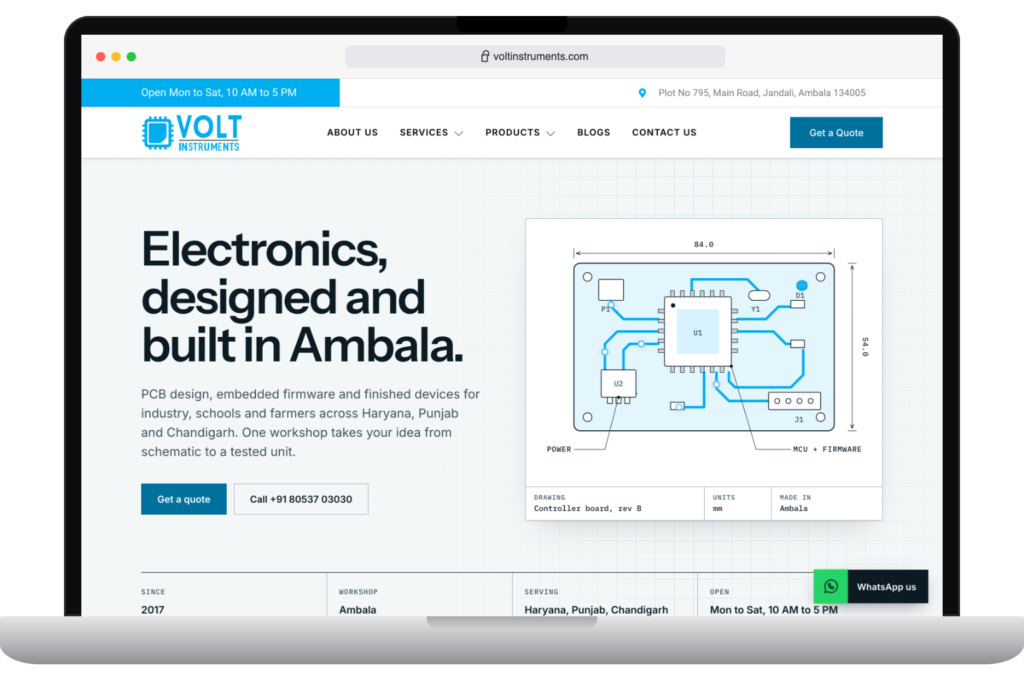
Our client designs and builds custom electronics in Ambala: PCB design, embedded firmware, control panels, pump controllers and lab kits for factories, schools and farms across Haryana, Punjab and Chandigarh. CodingCafe built a fast WordPress website that explains each service plainly, walks a visitor through the five steps from brief to tested unit, and takes a full enquiry with drawings attached.
- The problem
- Factory owners, teachers and farmers arrive with different questions, and custom electronics is hard to explain to any of them.
- What we built
- A WordPress site with one card per audience, a five-step path from brief to tested unit, and an enquiry form that takes drawings.
- What changed
- 100 out of 100 on accessibility, best practices and SEO, 99 to 100 on performance, on mobile. A 342 KB home page with no requests to other sites.Lighthouse 13.6, mobile, two runs, tested 28 Nov 2026
About the Project
The company runs an electronics workshop on the main road in Jandali, Ambala. Under one roof it draws schematics, lays out and prints circuit boards, writes firmware for microcontrollers, wires PLC and HMI control panels, and ships finished units such as water level controllers, grain moisture meters and programmable LED boards. Some orders are a single prototype for a factory. Others are a batch of lab kits for a college, or a pump controller that has to survive a field in Haryana.
That range is the whole difficulty. A factory owner, a physics teacher and a farmer arrive with different questions and no shared vocabulary. The website had to speak to all three, show that the work happens in a real workshop, and make it easy to send a brief with a sketch or a Gerber file attached.
Challenge We Tackled
Three things made this one harder than a standard business site.
- Three audiences, one page. Industry wants control panels and custom boards. Schools want kits with guides. Farmers want a pump controller that does not overflow the tank. The home page could not favour one without losing the other two.
- A product that is hard to picture. “PCB design and embedded systems” means little to most visitors. The site needed to show what a brief turns into, step by step, without reading like an engineering manual.
- Enquiries with attachments. A useful enquiry here is a photo of an old board, a rough sketch or a zip of design files, not a name and a phone number. The form had to take files, resist spam, and still work on a slow phone with JavaScript off.
On top of that, the page builder stack that came with the hosting loaded hundreds of kilobytes of scripts the site would never use. Visitors in small towns on mobile data would have paid for every one of them.
Our Approach
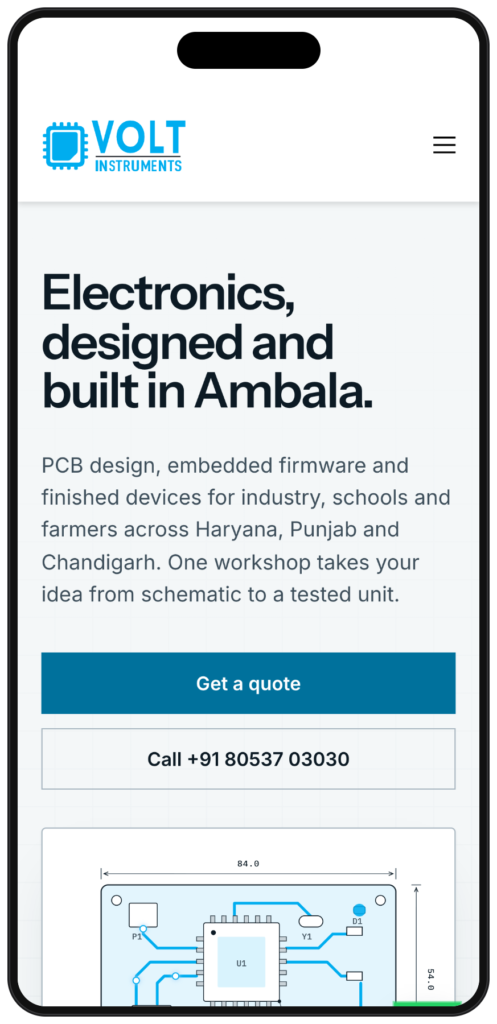
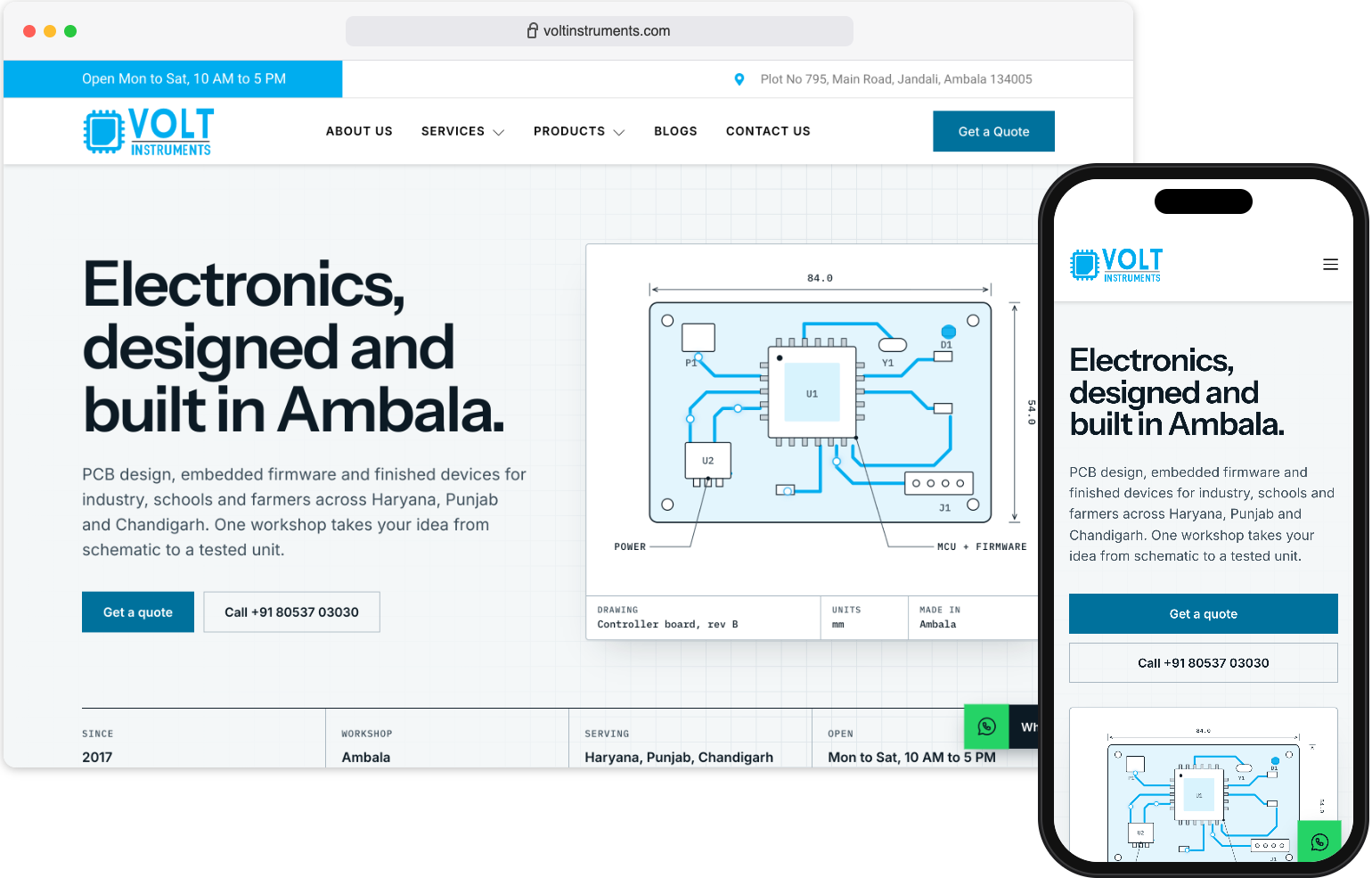
We built the site on WordPress with Elementor, then wrote a small set of custom must-use plugins for everything Elementor alone could not do well. The home page opens with a line-drawn controller board that draws itself in, with the company’s own numbers on it: units in millimetres, made in Ambala. From there the page is ordered the way a buyer thinks. What do you build? Is it for someone like me? What happens after I call?
The “who it is for” section gives industry, schools and farmers one card each, with a button that leads to the right service or product. Below it, a five-step path runs from brief to design, prototype, build and support. Each step lists what the workshop does, what the client receives, and the point where the client signs off before anything is made. That one section does most of the explaining.
Services and Products each got a hub page plus a page per item, all in the same layout: a short description, a “what’s included” list and an enquire button. The header holds a mega menu for both groups, and on phones a side panel menu reads the page tree, so a new product page appears in the menu by itself.
Under the hood
- A guided three-step enquiry form with up to three attachments, a hidden bot trap and rate limits. It works without JavaScript, saves each enquiry in the WordPress admin with a reference number, and emails the workshop.
- Fonts and icons are self-hosted. The icon font is cut down to the four glyphs the header uses, and the unused form plugin, Font Awesome and emoji scripts are stripped from the front end.
- Structured data for the business, breadcrumbs, each service page and each blog post, written by hand so no SEO plugin is needed.
- A blog listing and single post template in the same style as the rest of the site.
- Sticky header, a WhatsApp button on every page, and hardening on top of the firewall: hidden login, no user discovery, comments and application passwords off.
What We Delivered
One Card per Audience
Industry, schools and farmers each get a card on the home page that leads straight to the right service or product.
Five Steps With Sign-Offs
Brief, design, prototype, build and support, each showing what the workshop does, what the client gets, and where the client approves.
Enquiries With Drawings Attached
A three-step brief that takes up to three files, keeps bots out, works without JavaScript and lands in the admin with a reference number.
Service and Product Pages That Match
Seven service pages and five product pages in one layout: description, what's included, enquire button.
A Menu That Updates Itself
A mega menu on desktop and a side panel on phones, both built from the page tree, so new pages show up without editing a menu.
Lighter Than the Stack It Runs On
Self-hosted fonts, a four-glyph icon font and the unused plugin scripts removed, so the home page loads nothing from other sites.