 India


Quick answer
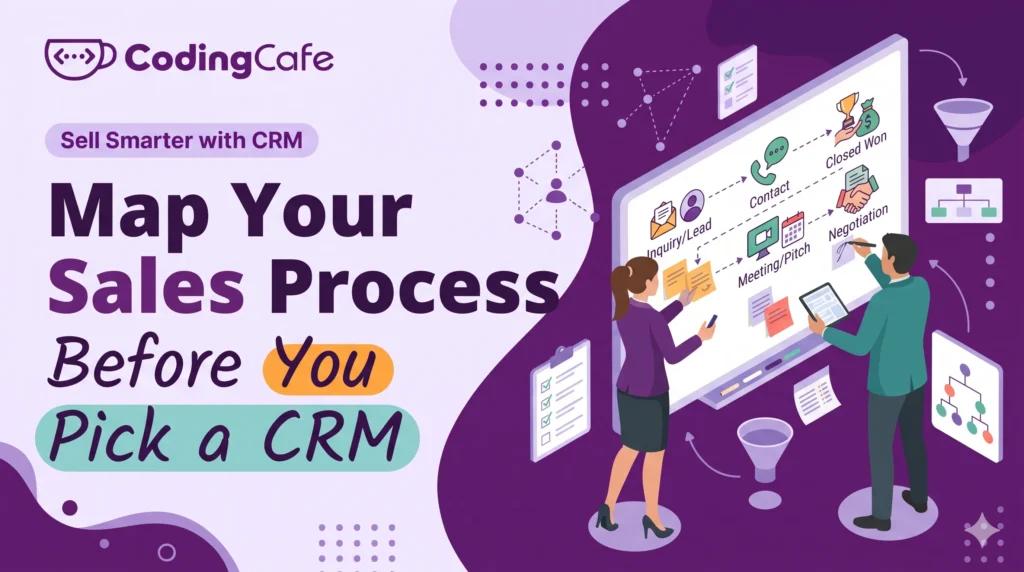
Before choosing a CRM, write down the stages a customer passes through in your business, from enquiry to repeat order. Find them by listing the steps of your last ten won deals and five lost ones; the steps common to most are your stages. Name each as a state, not an action, add a "lost, with reason" exit and an after-sale stage, and you have the one page every CRM is built around.
Key takeaways
- A stage is where a deal is, not what you did; most businesses need five to seven.
- Discover stages from your last ten won and five lost deals rather than inventing them.
- Where the lost deals stopped is the stage your CRM must watch most closely.
- Add "lost, with reason" and an after-sale stage; both are where learning and repeat business live.
Module 1 answered the “whether”. Module 2 is about the “how”, and it starts somewhere most businesses skip: before you compare a single CRM, write down how a customer actually moves through your business today.
This is called a sales process, or a pipeline. It is the single most important thing a CRM is built around, and it is the thing vendors assume you already have.
Most small businesses do not. Not written down, anyway.
What a Sales Stage Actually Is
A stage is a step a customer is at, not a thing you do. “Called the customer” is an activity. “Waiting for documents” is a stage. The difference matters because a stage answers the owner’s question, “where is this deal?”, while an activity only answers “what did we do?”
A good stage has three properties:
- Anyone can tell which stage a deal is in from what is written down, without asking the salesperson.
- Something specific has to happen to leave it. Documents arrive, a site visit is done, a quote is accepted.
- Deals can get stuck in it, which is useful, because stuck deals are what you want the CRM to show you.
Find Your Real Stages From Your Last Ten Deals
Do not invent a process. Discover the one you already have. It takes about an hour.
- Pick your last ten customers who bought, and five enquiries that did not.
- For each one, write the steps from first contact to money in the bank, in the order they happened. Use the words your team uses.
- Line the fifteen lists up side by side. The steps that appear in nearly all of them are your stages.
- Look at where the five lost enquiries stopped. That is the stage that needs the most attention in the CRM.
- Name each stage as a state, not an action, and write the one thing that has to happen to move on.
Most businesses end up with five to seven stages. If you have more than eight, some are activities in disguise. If you have fewer than four, you are probably hiding the step where deals get stuck.
A Worked Example: An Immigration Consultancy
Take a consultancy that helps people apply for study and work visas. Before the exercise, the owner described the process as “enquiry, then we file”. After listing ten real cases, the stages looked like this:
Enquiry → Eligibility check → Proposal sent → Documents collection → Application filed → Decision → After-landing services
Two things came out of it. First, three of the five lost enquiries had stopped at “Documents collection”, not at the proposal. Nobody had been chasing paperwork. Second, “After-landing services” had never been treated as a stage at all, although it was where repeat business and referrals came from.
Neither of those would have shown up in a CRM set up with the vendor’s default stages of Lead, Qualified, Proposal, Won.
How Other Industries Look
The method is the same everywhere. The stages are not.
Notice how different the middle is. A CRM that cannot name “site visit done” or “sample sent” as a stage will push your team back into WhatsApp to track the part that matters.
Too Many Stages, Too Few Stages
Too many
“Called once”, “Called twice”, “Sent brochure”, “Sent price list”. These are activities. In a CRM they become fields the team has to keep updating, and the pipeline view stops meaning anything. Fold them into the stage they belong to and log them as notes or tasks instead.
Too few
“New” and “Closed” is a list, not a pipeline. The stage where deals wait for the customer, for paperwork, for a decision, is the one the owner most needs to see, and it is the one that disappears when the pipeline is too short.
Add the Two Stages Everyone Forgets
Whatever your list, check it has these two.
Lost, with a reason. Every pipeline needs a way out that is not “won”. Recording why a deal was lost (price, timing, went elsewhere, not eligible) is how you learn where to improve.
After the sale. Delivery, onboarding, renewal, repeat order, referral. If the pipeline ends at “won”, the CRM forgets the customer at the moment they become valuable.
Give Each Stage an Owner and a Time Limit
Two more columns turn a list of stages into something a CRM can act on.
Owner. Who is responsible for moving a deal out of this stage? Not a department, a person or a role. In the consultancy above, “Documents collection” had no owner, which is exactly why deals died there. Once a case coordinator owned it, the chasing happened.
Time limit. How long should a deal normally sit here before someone should worry? Three days in “Enquiry”, two weeks in “Documents collection”, a month in “Decision”. These numbers do not have to be right first time. They are what lets the CRM flag a deal as stuck, which is the single most useful alert it will ever send you.
Owner plus time limit is also what makes handover painless. When a deal is stuck past its limit and its owner is on leave, the CRM can show it to someone else without anyone having to remember.
Write It Down, Then Keep It
The output of this lesson is one page: your stages in order, what has to happen to leave each one, and who owns it. The template below is that page.
That page is worth more than any feature comparison. Hand it to a CRM vendor and you will find out in five minutes whether their product can hold your process. Hand it to someone building a CRM around your business and it becomes the first screen they design.
Next lesson: what the CRM should know about each customer at each of those stages, and what it should not bother collecting.
Check what you learned
3 quick questions. Pick an answer and see why.
Which of these is a sales stage rather than an activity?
How should you find your sales stages?
Why add an after-sale stage?
You finished Lesson 1
Up next · Lesson 2 What Should a CRM Know About Each Customer? Read the next lesson Previous: Lesson 5 · 5 CRM Myths That Stop Small Businesses
Planning a CRM for your business?
We design and build CRMs around the way your team already works. Tell us about your process and we will suggest the simplest setup that fits.

