 India


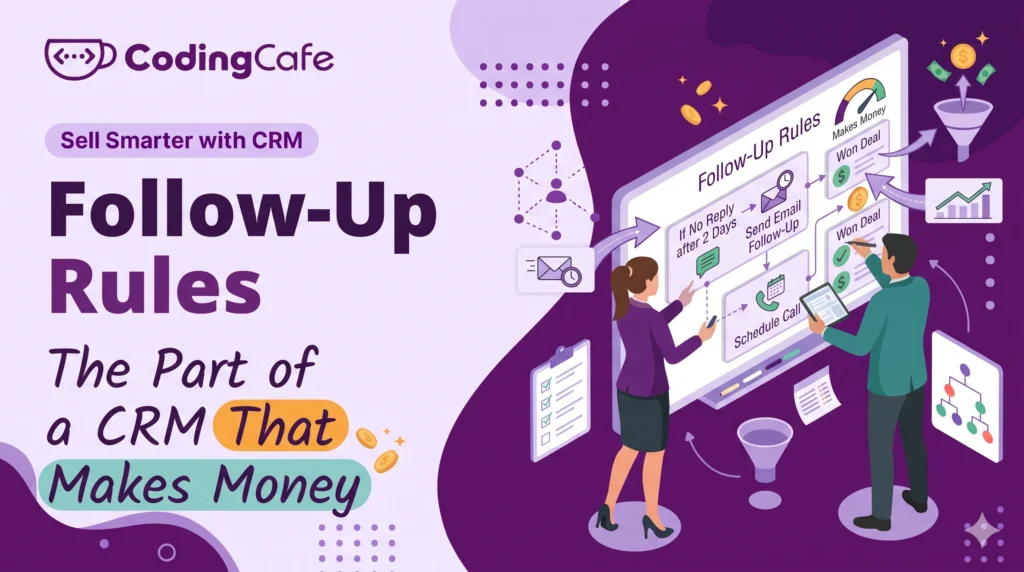
Quick answer
Most sales are lost because nobody followed up a second time, not because of price. A follow-up rule has a trigger, a first touch, a second touch, a long-term touch and a stop rule; four triggers (new enquiry, quote sent, waiting on the customer, won) cover most businesses. The CRM turns each rule into dated tasks, and an overdue list checked every morning makes sure they happen.
Key takeaways
- Sales are lost in silence; the second touch is the one most businesses never make.
- A rule has five parts: trigger, first touch, second touch, long-term touch, stop rule.
- Every touch gives the customer a question, something useful or a next step; never "just checking in".
- The overdue list, looked at daily by one named person, is what turns rules into results.
Ask a business owner where sales are lost and they will talk about price, competitors and the market. Look inside their CRM, or their spreadsheet, and the answer is usually simpler.
Most sales are lost in silence.
The enquiry came in, somebody replied once, the customer did not answer straight away, and nobody went back. Not because anyone decided to give up. Because nothing told them to continue.
Follow-up rules fix that. They are the least glamorous part of a CRM and the part that pays for it.
Why “Follow Up When You Can” Fails
Left to judgement, follow-up follows mood. The salesperson chases the deal that feels close and the customer who was friendly. The quiet enquiry that needed one more nudge gets none. By the time the week is over, the “when you can” has become “never”.
A rule removes the judgement from the easy part. The CRM decides when. The person decides what to say.
A real estate agency that introduced a simple three-touch rule found that about a third of its “lost” enquiries from the previous quarter were not lost at all. They had just never been called a second time.
The Shape of a Follow-Up Rule
Every rule has the same five parts, whatever the business.
- Trigger. The situation that starts it: new enquiry, quote sent, waiting on documents, deal won.
- First touch. How soon, and how. “Within one hour, call; if no answer, WhatsApp with one question.”
- Second touch. The follow-up most businesses never make. “Day 2, call at a different time of day.”
- Long-term touch. What happens if the customer goes quiet but has not said no. “Day 7 and day 21, send something useful.”
- Stop rule. When to mark it lost and move on, so nobody chases forever and nobody gives up too early.
Written out for a new enquiry, it reads like this:
New enquiry — 1st: within 1 hour, call, then WhatsApp if no answer — 2nd: day 2, call at a different time — Long-term: day 7 and day 21, short message with something useful — Stop: after 3 silent touches, mark Lost (no response), monthly nurture only
That one line, entered as a rule in the CRM, becomes a task on someone’s screen every time an enquiry arrives. Nobody has to remember it again.
Four Rules Cover Most Businesses
You do not need a rule for every stage. Four triggers cover nearly everything.
An immigration consultancy adds a fifth, “application filed”, with touches tied to expected processing times so the customer hears from them before they have to ask. A manufacturing distributor adds “sample sent”. Your sales stages page from Lesson 1 tells you which extra triggers you need.
What a Good Touch Contains
“Just checking in” is the message everyone ignores. Each touch should give the customer a reason to reply or something worth having.
- A question with an easy answer. “Is the two-bedroom still the priority, or would a three-bedroom in the same budget interest you?”
- Something useful. A price list, a comparison, a short article like this one, a photo of the sample batch.
- A next step with a time. “Shall I hold Thursday 4pm for a site visit?”
- Permission to say no. On the last touch: “If the timing is not right, tell me and I will stop chasing.” People reply to that.
The CRM can hold these as templates, so a touch is one tap plus a personal line, not a blank screen.
The Overdue List
Rules create tasks. Tasks get missed. The piece that makes the whole system work is a single screen the owner or sales manager looks at every morning: every follow-up that is overdue, who owns it, and how many days late it is.
Three decisions make it useful:
- Who looks at it and when. Daily at 9:30 beats “sometime”.
- After how many days overdue a deal is reassigned. Three days is common. The salesperson knows this, which is usually enough to prevent it.
- Which touches can be automatic messages and which must be a human. Reminders and useful links can be automatic. A call after a quote cannot.
Without the overdue list, rules are good intentions. With it, they are management.
Keep It Realistic
The most common failure is a rule set the team cannot keep. Five touches on every enquiry sounds thorough and dies in a fortnight. Count the enquiries you get in a week, multiply by the touches in your rules, and check that the result fits the hours your team has. If it does not, cut touches rather than skip them.
A rule that is always followed beats a better rule that is followed when convenient.
Write Your Rules
The template below has the four common triggers filled in as examples and blank rows for your own. Write each touch as “when, how, what”, decide the stop rule, and fill in the three overdue-list decisions at the bottom. With your stages page and your customer record checklist, this completes the three pages that describe your CRM.
Those three pages are also exactly what a custom CRM turns into screens, reminders and the overdue list, without the team having to remember any of it.
Next lesson, the last in this module: getting the team to use all of this, which is where most CRM projects quietly fail.
Check what you learned
3 quick questions. Pick an answer and see why.
According to the lesson, where are most sales lost?
What is the purpose of a stop rule?
Which of these is a good follow-up message?
You finished Lesson 4
Up next · Lesson 5 Getting Your Team to Actually Use the CRM Read the next lesson Previous: Lesson 3 · Capturing Enquiries From Website, WhatsApp and Phone in One Place
Planning a CRM for your business?
We design and build CRMs around the way your team already works. Tell us about your process and we will suggest the simplest setup that fits.

